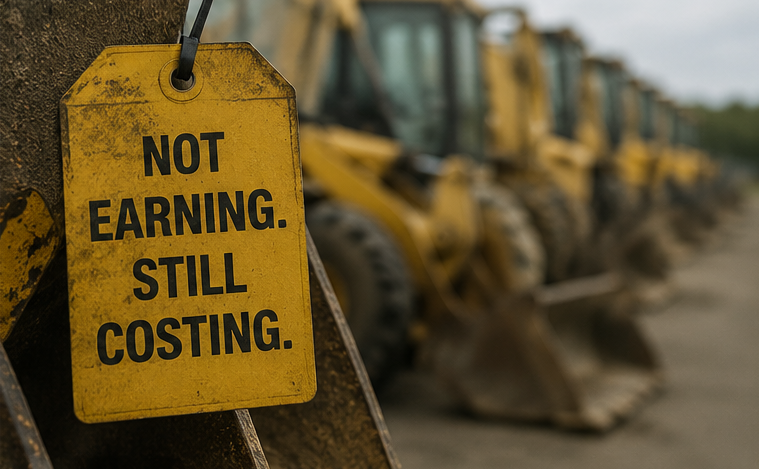
The Hidden Cost of Idle Equipment
For contractors and construction business owners, equipment is often viewed as an investment. This article covers how you can lose money by holding on to assets that you no longer need.
Excavators, skid steers, loaders, trailers, dump trucks, service vehicles, lifts and other transportation assets are essential tools of the trade. They help get projects completed, crews productive and jobs moving.
But there is another side to equipment ownership that is easy to overlook: Equipment that isn’t working can still be costing you money.
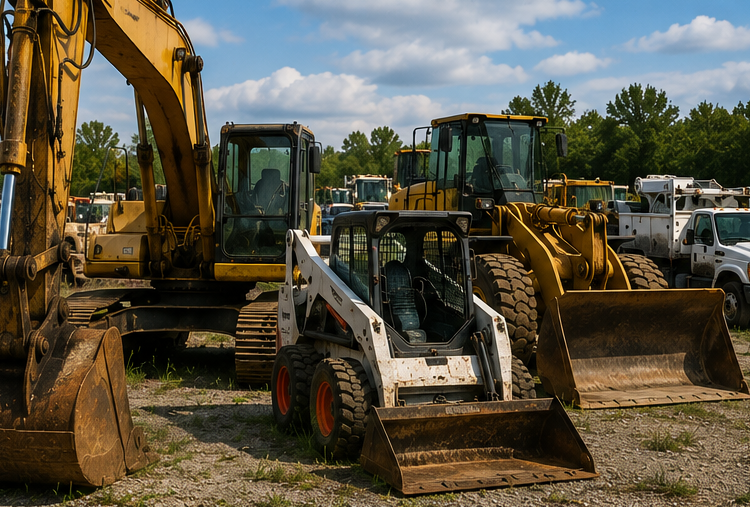
A machine sitting behind the shop or a truck parked in the yard may not be generating revenue, but it continues to consume capital, space, maintenance resources and management attention. And the longer an asset sits idle, the more expensive that decision can become.
One of the most common reasons contractors hold on to idle equipment is simple: We might need it someday. That may be true. But “we might need it” can become an expensive justification for keeping assets that have not generated meaningful revenue in months—or even years.
Perhaps an older excavator was replaced but the old one was kept as a backup. A trailer was retained after a project ended. A dump truck hasn’t been needed since a particular contract was completed. A piece of specialized equipment was purchased for a large job and has barely moved since.
The asset remains in the yard because selling it feels like giving up an option. The problem is that option has a cost.
Idle equipment still costs money!
An asset does not have to be operating to affect your bottom line. Consider some of the costs associated with keeping idle equipment:
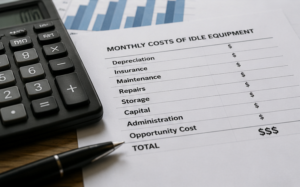
- Depreciation: Equipment generally continues to lose value as it ages.
- Insurance: You may continue paying insurance and registration costs whether the asset is working or sitting still.
- Maintenance: Even idle equipment requires inspections, servicing, battery maintenance, tire care and other attention.
- Repairs: Older equipment can deteriorate while sitting, potentially creating expensive repair requirements before it can return to service.
- Storage: Yard space isn’t free. Every trailer, truck or machine occupying space is using an asset that could potentially be put to another use.
- Capital: Money tied up in unused equipment cannot be invested elsewhere in the business.
- Administration: Equipment has to be tracked, maintained, insured, registered and eventually disposed of.
- Opportunity cost: Perhaps most importantly, the capital tied up in idle equipment could be used for equipment that actually generates revenue.
None of these expenses necessarily appear on a single line item labeled “cost of idle equipment.” And that’s what makes them easy to overlook.
The Bigger Problem
Your Equipment Isn’t Just an Asset—It’s Capital
A $100,000 machine sitting unused isn’t simply a machine. It’s $100,000 of capital that isn’t doing much for the business.
That capital could potentially be used to:
- Purchase newer, more productive equipment
- Reduce debt
- Improve cash flow
- Fund payroll during slower periods
- Purchase materials
- Take on another project
- Invest in technology
- Build working capital
- Strengthen the company’s balance sheet
This is where contractors need to look beyond the question, “How much is this machine worth?”
A better question is:
“What is this machine doing for my business today?”
If the answer is “not much,” it may be time to reconsider keeping it.
Depreciation doesn’t stop because the equipment is sitting still. Many business owners understandably think of depreciation as an accounting issue. But depreciation also has a very real economic impact.
Our appraisals and valuations team are ready to help you put current market values on your idle equipment and discuss viable options to achieve the best return on selling your assets.
Construction equipment and transportation assets are generally depreciating assets. As equipment becomes older, newer models enter the market and technology changes, its resale value can decline.
An asset that could have been sold for a strong price two years ago may be worth substantially less today. Meanwhile, it may have generated little or no revenue during that period. That’s a particularly frustrating combination!
The equipment isn’t earning money, and it’s becoming worth less.
Holding an idle asset therefore creates a potential double loss—lost productivity and declining resale value.
“But We Already Paid for It” is another common reason equipment stays in the yard. A contractor may think “We’ve already paid for it, so there’s no reason to get rid of it.” But the money you paid for the asset is a sunk cost. The relevant question today is what you can do with the asset’s current value.
Suppose an older truck is worth $40,000 today but has produced little revenue in the past year. Keeping it doesn’t preserve the original investment. That money is already gone.
The decision is now between keeping a $40,000 asset that may or may not be useful in the future or selling the asset and redeploy the proceeds into something that may provide a better return.
Thinking this way can make equipment decisions much more objective.
The Yard Can Hide the Problem
Idle equipment is particularly easy to ignore when you have adequate yard space. A machine gets parked behind the shop. A trailer is moved to the back corner. An old truck sits beside the fence. After a while, it becomes part of the landscape.
But every asset sitting in that yard should periodically be challenged. Consider:
- When was the last time this asset generated revenue?
- When is it realistically expected to generate revenue again?
- What would it cost to put it back into productive service?
- What could we get for it if we sold it today?
- What could we do with that money instead?
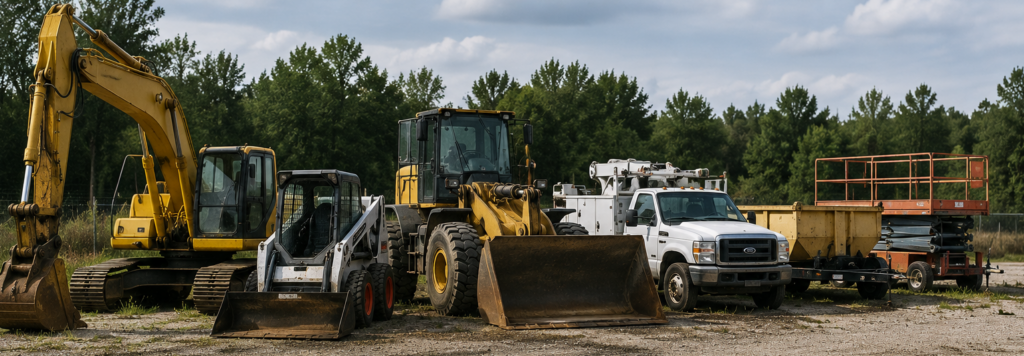
Those questions can quickly reveal assets that have outlived their usefulness.
Transportation assets can be especially expensive to hold as well. The same principle applies to trucks, trailers, vans and other transportation assets.
A vehicle can sit idle while still accumulating costs associated with:
- Insurance
- Licensing and registration
- Depreciation
- Maintenance
- Tires
- Batteries
- Repairs
- Storage
- Financing or interest costs
Transportation assets can also become increasingly difficult to sell as they age. If a company knows that a particular truck or trailer is unlikely to be needed again, delaying the sale may simply mean accepting a lower price later.
Don’t Confuse “Backup” With “Necessary”
Having backup equipment can be smart. Downtime is expensive, and contractors need to be able to respond when equipment fails or an unexpected project comes along. But there is a difference between maintaining a sensible backup strategy and keeping every older machine “just in case.”
Ask yourself: How much backup capacity does the business actually need?
If you have three excavators and only regularly require two, for example, is the third one a necessary contingency—or is it simply an asset that hasn’t been sold? The answer should be based on actual business requirements rather than habit.
A Simple Equipment Audit Can Reveal a Lot
You don’t necessarily need a complicated system to identify your underperforming assets. Start with an inventory of every major piece of equipment and transportation asset and assess:
| Question | Why It Matters |
| What is it worth today? | Establishes the capital tied up in the asset |
| How often has it been used? | Identifies underutilization |
| When was it last used? | Highlights truly idle assets |
| What does it cost annually? | Reveals the carrying cost |
| What repairs are coming? | Helps identify future expenses |
| When will it realistically be needed? | Tests the “we might need it” argument |
| What could the business do with the sale proceeds? | Identifies the opportunity cost |
You may discover that some assets are earning their keep. Others may not be.
The 12-Month Test
One simple rule can be particularly useful: If you haven’t used an asset meaningfully in the last 12 months, ask why you still own it.
This doesn’t mean every asset unused for a year should automatically be sold. Specialized equipment, seasonal equipment and emergency backup assets may have legitimate reasons for being retained. But a year of inactivity should trigger a serious review.
And if the answer is simply, “We might need it someday,” that may not be a strong enough reason to keep tying up capital.
Selling Isn’t Failure—It’s Capital Management
Some contractors hesitate to sell equipment because it feels like admitting that the company made a bad purchase. It doesn’t have to be viewed that way.
Businesses change. Projects change. Markets change. Equipment requirements change.
A machine that was an excellent investment five years ago may no longer make sense today. Selling it can be a sign of good management—not poor planning. Black Star is constantly evaluating market conditions and knows the best time and approach to give you the optimum return on your investment.
The goal isn’t to own the most equipment. The goal is to own the equipment that makes the most sense for the business.
Don’t Wait Until the Equipment Becomes a Problem
One of the worst times to sell an asset is when you suddenly need cash and discover that the equipment you own is worth considerably less than expected.
A better approach is to review the fleet regularly and identify assets that are approaching the end of their productive business life.
If an asset is underutilized, expensive to maintain and unlikely to be needed in the foreseeable future, selling it while there is still a healthy market may make more sense than holding it until it becomes obsolete or requires a major repair.
The objective isn’t simply to get rid of equipment. It’s to sell at the point where the asset’s remaining value is greater to someone else than its expected value to your company.
Turn Your Idle Iron Into Working Capital
For many contractors, the yard contains a surprising amount of dormant capital. Equipment that isn’t generating revenue can often be converted into cash. That cash can then be put to work where it has a better chance of producing a return.
Before holding on to an idle machine for another year, consider the alternatives:
- What if we sold it?
- What could we do with the proceeds?
- What will it cost us to keep it for another year?
- What will it likely be worth a year from now?
Those questions can turn equipment management from a matter of habit into a business decision.
The Bottom Line
Construction equipment is supposed to support the business—not quietly drain it. Every machine, truck, trailer and transportation asset should have a purpose. If an asset is consistently generating revenue or providing essential operational value, keeping it may make perfect sense. But if it has been sitting idle, depreciating and consuming money and space, it deserves a closer look.
Don’t let the equipment yard become a warehouse for stranded capital.
Review what you own. Identify what you actually use. Calculate the cost of holding what you don’t. And when an asset no longer earns its place in the fleet, consider selling it while it still has value.
Sometimes, the most profitable piece of equipment is the one you finally decide to let go.
Partner with Black Star to identify your true equipment values, recognize those units that don’t serve you well, discover the best time to sell based on current market conditions, and make sure you to get the most return for your idle assets.